
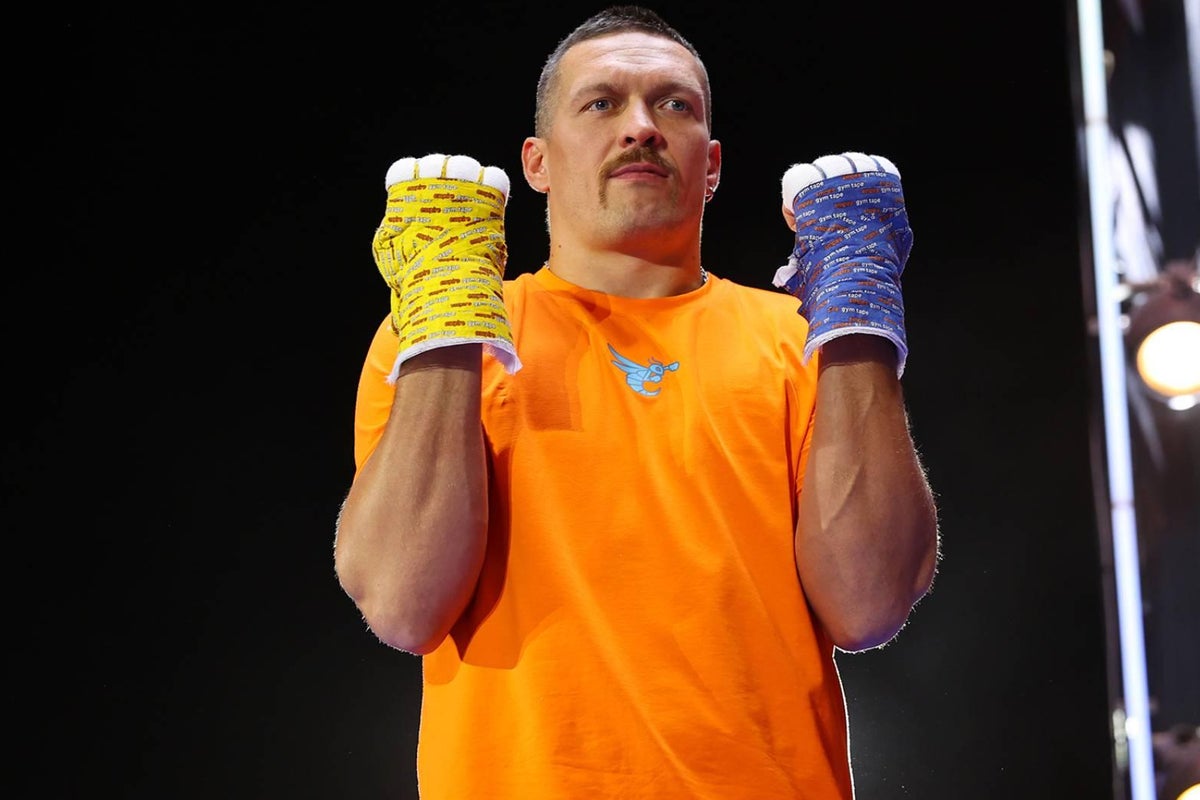
Despite being a cruiserweight by nature, Oleksandr Usyk has come to dominate the heavyweight division, repeatedly felling fighters many expected him to come unstuck against. So what is he doing differently?
There is a lot to unpack, from genetics to precise footwork – the latter may, or may not, owe something to his penchant for dancing. But from a strength training standpoint, there is one tool he appears to use more than his competitors: the kettlebell.
Catch all the latest boxing action on DAZN
Despite being commonplace in modern gyms, the kettlebell was only popularised in the US and UK in 1998 by leading strength coach Pavel Tsatsouline. Its origins lie in 18th century Russian markets where similar cast iron weights called girya were used to measure grains and other goods. However, when people discovered their strength-building potential, they were soon repurposed.
In a training video from December 2024, shared by Usyk’s strength and conditioning coach, the boxer uses several kettlebell exercises including the bottoms up kettlebell press, American kettlebell swing, staggered stance kettlebell snatch and a variation of the half Turkish get-up. Prior training footage has also shown him use this training tool on a regular basis.
The kettlebell is not responsible for Usyk’s success, but it can develop many physical attributes that are beneficial to boxers, as well as other athletes and even recreational lifters.
Developing full-body tension
How often do you hear personal trainers and coaches tell people to ‘brace your core’? The problem is, to the untrained ear, this instruction means very little.
If you train with a kettlebell, you will soon learn the meaning of the phrase alongside several other foundational strength training principles, expert Tsatsouline argues.
“It’s very easy to teach the body language of strength with a kettlebell, especially contracting your abs properly,” he told the Huberman Lab podcast. “With a kettlebell, if you start doing double front squats with a pair of kettlebells, your abdominal wall is going to light up and you suddenly learn, ‘Oh, this is what it means to get tight’.”
He went on: “Or you stick your elbows inside your knees and do a goblet squat then go, ‘Oh, this is what the proper squat feels like’.”
A strong core and total-body tension are vital in boxing. The mid-body muscles not only need to be able to withstand significant impacts, but they also need to be able to transfer power between the lower and upper body as a punch is thrown from the ground up. Kettlebell training lays strong foundations in this area.
Coordination
The most easily identifiable movement within a punch is elbow extension. The primary muscles responsible for this are the triceps. By recreational bodybuilding logic, this could be seen as a triceps exercise. But that is not how sport works.
The punch is a full-body movement. It involves the entire kinetic chain to generate force through the floor, transfer it through the legs to the core, then unleash it via the upper body extremities – the shoulder, arm, wrist and hand.
Coincidentally, this is also the case with many total-body kettlebell exercises like the snatch and clean and jerk. While not teaching you the exact movement pattern of the punch, they develop the general ability to coordinate muscular contractions and achieve a desired outcome.
Ballistic exercises
With a dumbbell and a barbell, the centre of mass lies in the middle of the handle. This is not the case with kettlebells, making them a good fit for ballistic exercises – dynamic movements which demand speed and power rather than just straight-up strength.
As an example, compare the kettlebell swing to a standard barbell deadlift. Both exercises require you to hinge at the hip, but while the latter simply involves moving the weight from the floor to your waist at any speed (a display of strength), the former requires rapid muscular contraction of the glutes to propel the kettlebell forward explosively (a display of power).
Given power equals work divided by time, and a punch that lacks power is a poor tool for finishing a fight, this is another attribute worth developing.
Stability
The shoulder joint is complex and subjected to myriad stimuli over the course of a boxing match. It has to generate force, absorb impacts and articulate through a wide range of motion at speed, so it pays to strengthen it.
The body adheres to the SAID principle, which stands for specific adaptations to imposed demands. So, if you want to strengthen your joints in certain positions, you need to expose them to these positions consistently, gradually adding load over time.
Machine exercises, as well as many dumbbell and barbell moves, tend to develop strength through a set movement pattern – usually pressing overhead. Kettlebells allow for more freedom of movement, allowing you to access a wider range of positions around the shoulder with exercises like the kettlebell halo and snatch. This helps to develop a more robust joint.
Using exercises like the bottoms up kettlebell press which is demonstrated by Usyk in the video above – hold the kettlebell in one hand with the bell above the handle then press it overhead – you can also introduce an element of instability into your training. This can develop stability in and around the shoulder joint, reducing injury risk.
Watch the very best boxing with a DAZN subscription
DAZN is the home of combat sports, broadcasting over 185 fights a year from the world’s best promoters, including Matchroom, Queensberry, Golden Boy, Misfits, PFL, BKFC, GLORY and more.
An Annual Saver subscription is a one-off cost of £119.99 / $224.99 (for 12 months access), that’s just 64p / $1.21 per fight. There is also a Monthly Flex Pass option (cancel any time) at £24.99 / $29.99 per month.
A subscription includes weekly magazine shows, comprehensive fight library, exclusive interviews, behind-the-scenes documentaries, and podcasts and vodcasts.
For pricing in your country, more information and to sign up click here.